
Capture spoken verification
Medical speech recognition supports naturally spoken safety checks during perioperative workflows.
An AI-powered Smart Operating Room platform for voice-driven three-party safety checks, structured surgical records and digital authentication—developed through hospital collaboration in Huzhou, China.
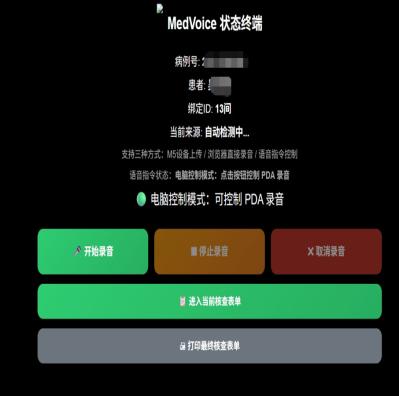

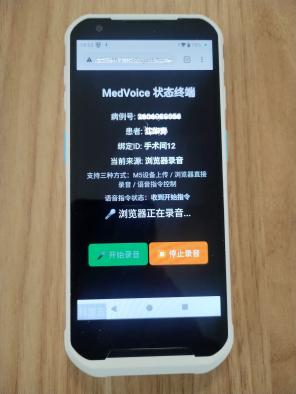
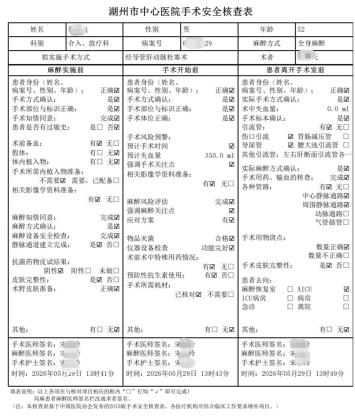
Images reproduced from the MedVoice v6 presentation (July 2026). For product illustration; not a live clinical demonstration.
Medical voice AI · Three-party verification · Digital signatures · Local deployment
Operating-room teams must coordinate surgical safety checks while maintaining accurate records. MedVoice helps capture verbal confirmations, organize checklist responses and support staff review without replacing professional judgment.
Medical speech recognition supports naturally spoken safety checks during perioperative workflows.
AI-assisted extraction maps relevant confirmations to surgical safety checklist fields for review and correction.
Designated clinical staff verify entries, apply signatures and archive finalized documentation.
Based on the three-stage perioperative safety verification workflow developed for the Huzhou hospital project. Actual checklist content is configured to local hospital policy.
Support verification of patient identity, procedure, consent, surgical site and anesthesia-related readiness before anesthesia begins.
Help capture team confirmations of patient, planned procedure, surgical site, anticipated concerns and readiness before incision.
Assist with recording final checks such as instrument and sponge counts, specimen handling, procedure documentation and handoff items.
AI-generated checklist entries are drafts until verified by authorized healthcare professionals. Required checks must not be inferred from silence.
Based on the MedVoice v6 project workflow: initiate the anesthesia-system session, register the clinician, capture speech using a PDA device, then generate a reviewable form for verification and digital signatures.
Open a workflow from the anesthesia system and register an authorized clinician, including QR-based registration where configured.
Register an authorized clinician through the QR-based workflow where configured.
Capture authorized staff confirmations using an operating-room handheld device and medical speech recognition.
Surgeon, anesthesiology and nursing personnel confirm entries and complete configured digital authentication.
Produce the completed form and pass approved documentation into configured hospital record workflows.
Screens from the July 2026 project presentation show the registration, handheld voice workflow, and generated surgical safety form.
MedVoice combines medical AI, speech processing, structured documentation and clinician-controlled verification in a hospital-oriented architecture.
Medical terminology and perioperative workflow language support.
Medical speech recognition designed for noisy OR conditions and specialized vocabulary.
Convert spoken confirmations into structured reviewable medical forms.
Support multidisciplinary surgical safety verification and process tracking.
Enable private deployment architectures and hospital-controlled processing.
Support clinician identity verification and digitally signed documentation.
The July 2026 MedVoice project presentation reports the following milestones and levels of hospital engagement.
Intent/framework cooperation agreement established.
One-year MedVoice development collaboration signed with Huzhou Central Hospital.
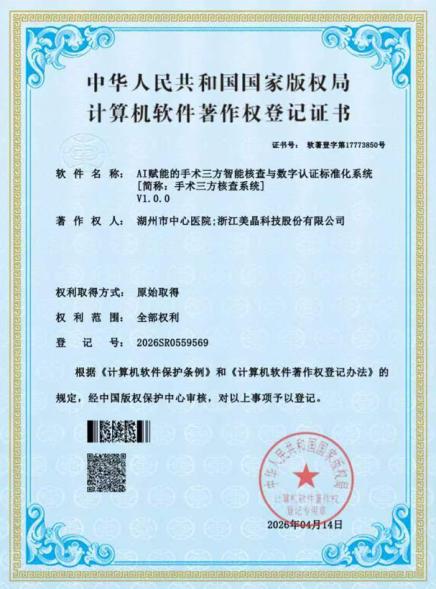
Chinese software copyright registration reported for “AI-Enabled Three-Party Surgical Intelligent Verification and Digital Authentication Standardized System V1.0” (2026SR0559569).
MedVoice completed an operating-room connected-system test, as reported by the project team.
Guanghan People's Hospital: needs research and functional validation.
These are development and engagement milestones, not a claim of regulatory approval, production deployment at every institution or independently established clinical outcome improvements. Publication of hospital names and collaboration details should be authorized.
MedVoice supports on-premises and local-processing architectures designed for hospitals that need operational control of sensitive clinical data.
Discuss hospital integration →Keep voice-processing services and record workflows within hospital-managed infrastructure when configured for on-premises use.
Support project-specific connections to HIS, EMR, anesthesia systems and other clinical systems, subject to interface availability.
Provide an auditable path from draft checklist to clinical verification, electronic signatures and finalized printable records.
Adapt clinical terminology, forms and operating-room procedures to the participating hospital.
MedVoice’s project materials describe collaborative development with Huzhou Central Hospital (湖州市中心医院), including requirements research, real-setting operating-room workflow tests, voice-based surgical verification and clinician feedback.
Our focus is practical assistance for surgical teams, with human verification of clinical records and configurations tailored to hospital needs.
Project testing and technical implementation should not be interpreted as regulatory clearance, demonstrated improvement in clinical outcomes, or universal availability across hospitals.
 Portrait from the July 2026 MedVoice project presentation
MedVoice founder and project leader
Keefer Chern leads the MedVoice Smart Operating Room project, combining biomedical engineering, computing, and healthcare AI product development. His background includes study at Johns Hopkins University, graduate-level bioengineering research at UC Berkeley, and healthcare AI venture experience with Asclep.ai in the United States.
Background based on the MedVoice project presentation dated July 22, 2026.
Discuss MedVoice demonstrations, operating-room processes, local deployment and system integration.